What Is an MSP Lead? Defining Leads, MQLs, SQLs, and Opportunities
Ask three MSPs how many leads they generated last month and you may get three numbers built on three different definitions. One MSP counts every business that asks about IT support. Another removes companies that are too small. A third waits until a salesperson has completed a discovery call.
All three may call the result “MSP leads,” but they aren’t measuring the same thing. That makes it hard to compare SEO, Google Ads, referrals, events, agencies, lead providers, and internal marketing teams.
We recommend a simpler standard: An MSP lead is a business actively looking for IT support or another service traditionally provided by an MSP.
A lead describes demand. Qualification describes whether that demand is valuable to your MSP. Keeping those ideas separate gives marketing and sales a common starting point without forcing every MSP to use the same ideal customer profile.
What Is An MSP Lead?
An MSP lead is a business actively looking for a service an MSP would traditionally provide. That may include managed IT services, IT support, cybersecurity, co-managed IT, cloud services, backup and disaster recovery, Microsoft 365 services, or business phone systems.
Nothing else is required for the business to count as a lead. It doesn’t need to have a minimum number of employees, operate in a preferred industry, live within your service territory, use a particular technology stack, meet a monthly recurring revenue threshold, or be ready for a proposal.
Those details help you decide whether the lead is qualified. They don’t erase the demand that brought the business to you.
Why MSPs Need A Standard Definition Of A Lead
Imagine a campaign that generates 40 inquiries from businesses looking for managed IT services. If you call only the 12 that match your ideal customer profile “leads,” you lose the ability to see two separate results:
- The campaign generated 40 instances of active demand.
- Thirty percent of that demand matched your target market.
Both numbers are useful. Combining them hides the difference between demand volume and lead quality.
This distinction becomes especially important when comparing demand capture and demand generation, or reviewing results across SEO, paid search, referrals, events, and outbound campaigns. “We generated 40 leads” should mean roughly the same thing across channels. What happens to those leads next is where company-specific qualification begins.
What Is An MQL For An MSP?
A marketing qualified lead, or MQL, is an MSP lead that also meets your predefined target-market requirements. Unlike the lead definition, the MQL definition should be company-specific.
For example, your MSP might define an MQL as a business with at least 10 employees, located within your service area, operating in healthcare, and looking for a service you provide. A three-person retailer asking for IT support is still an MSP lead. It simply isn’t an MQL for your MSP.
Lead = demonstrated demand. MQL = demonstrated demand plus target-market fit.
MQL definitions vary widely across companies. HubSpot’s MQL guidance also recommends that marketing and sales agree on the criteria used to qualify leads. For an MSP, those criteria can include firmographics, geography, service fit, and any other attributes that define a worthwhile target account.
What Is An SQL For An MSP?
A sales qualified lead, or SQL, is a lead the sales team accepts for a legitimate sales conversation.
The result of that conversation doesn’t change whether the lead reached the SQL stage. Sales may learn that the budget is too small, the timing is wrong, the technical requirements are unusual, or another provider is a better fit. Marketing still delivered a lead that sales accepted and chose to engage.
MQL = marketing says the company fits the target market. SQL = sales accepts the lead for a sales conversation.
This definition also prevents teams from rewriting history. An SQL shouldn’t disappear from the reporting just because the call didn’t produce an opportunity.
What Is An MSP Sales Opportunity?
Not every SQL becomes an opportunity. An opportunity begins when sales determines that a potential deal is qualified enough to pursue through the sales process.
A salesperson can have 10 valid conversations without deciding that all 10 deserve a proposal or continued follow-up. That doesn’t make the conversations invalid. It means sales applied another level of qualification.
SQL = this conversation is worth having. Opportunity = this potential deal is worth pursuing.
This matches the practical difference found in many CRM processes. Salesforce describes an opportunity as a qualified lead that has become a viable business deal.
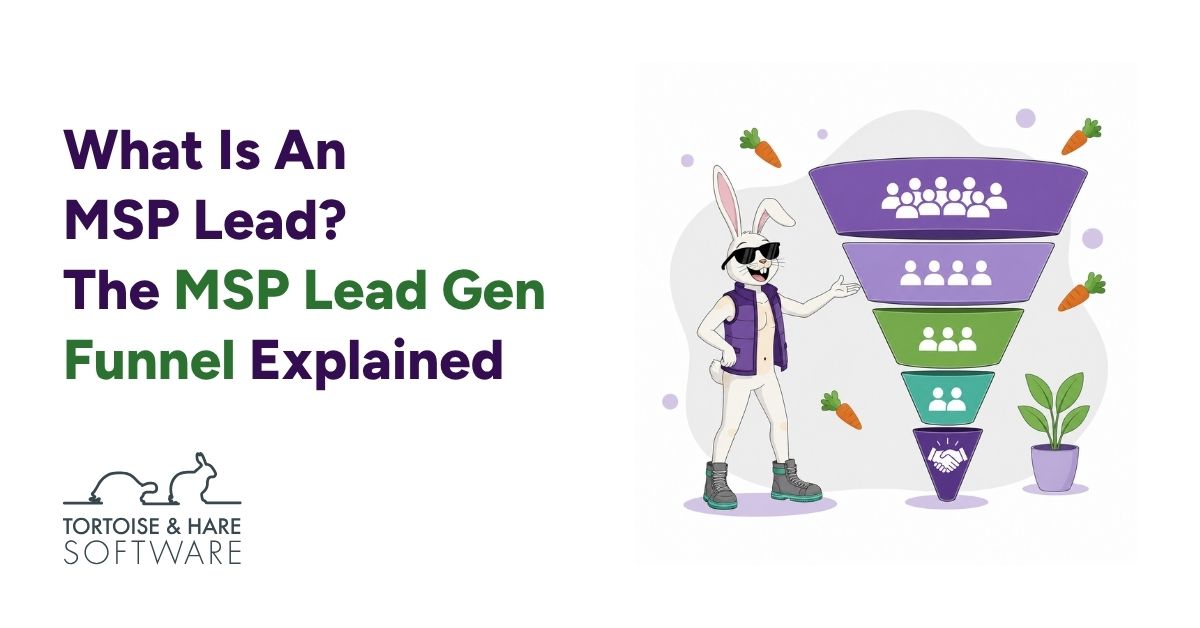
The Complete MSP Lead Funnel
| Stage | Standard Definition |
|---|---|
| Lead | A business actively looking for an MSP-related service. |
| MQL | A lead that meets your MSP’s target-market requirements. |
| SQL | A lead that sales accepts for a sales conversation. |
| Opportunity | An SQL that sales believes is worth pursuing as a potential deal. |
| Closed Deal | An opportunity that becomes a customer. |
The progression is simple: Lead → MQL → SQL → Opportunity → Closed Deal. The lead stage uses a universal definition. Each later stage applies a more specific business decision.
Why MSPs Should Measure Every Stage
Closed deals are important, but they can’t tell you where a marketing or sales problem began. Measure each stage and its conversion rate:
- Total leads: Are you generating enough demand?
- Lead-to-MQL rate: Are you attracting the right companies?
- MQL-to-SQL rate: Are qualified prospects reaching and engaging with sales?
- SQL-to-opportunity rate: Is sales finding worthwhile deals in those conversations?
- Opportunity-to-close rate: Can sales convert viable deals into customers?
Track cost per lead, MQL, SQL, and opportunity alongside customer acquisition cost. Each number diagnoses a different part of the system. This is also why an MSP marketing strategy needs shared reporting definitions before channels can be compared fairly.
More MSP Leads Create More Chances To Win Deals
Consider a hypothetical MSP with this funnel:
100 leads → 50 MQLs → 25 SQLs → 10 opportunities → 3 closed deals
If its conversion rates stay about the same and marketing doubles lead volume, the funnel could look like this:
200 leads → 100 MQLs → 50 SQLs → 20 opportunities → 6 closed deals
This is an illustration, not a forecast. Conversion rates rarely remain perfectly fixed. Still, every later stage begins with the businesses entering the funnel. More qualified MSP sales leads can’t appear unless enough demand enters at the top.
Lead quality still counts. A program that generates 100 leads and two MQLs may perform worse than one that generates 50 leads and 30 MQLs. But the other 98 inquiries were still leads. The first program had a poor lead-to-MQL conversion rate.
Measure volume and qualification separately. That lets you see whether you need more demand, better targeting, stronger sales follow-up, or a higher close rate. It also makes changes in MSP lead generation easier to evaluate without moving the measurement line.
Make MSP Lead Reporting Easier To Compare
Stop redefining “lead” until the top-line report looks better. Start with one broad definition, then let marketing, sales, and the deal process apply their own qualification standards in sequence.
When you evaluate an agency, vendor, campaign, or channel, ask how many leads it generated, what percentage became MQLs, what sales accepted, how many became opportunities, how many closed, and what each stage cost. Those answers tell you much more than an argument over whether an inquiry was “good.”
At Tortoise and Hare Software, we help MSPs build marketing programs that generate demand and make performance easier to understand.
Ready to create more measurable demand for your MSP? Book A Free Consultation.
About The Author