Google Spam Updates In 2026: How B2B Tech Has Been Affected
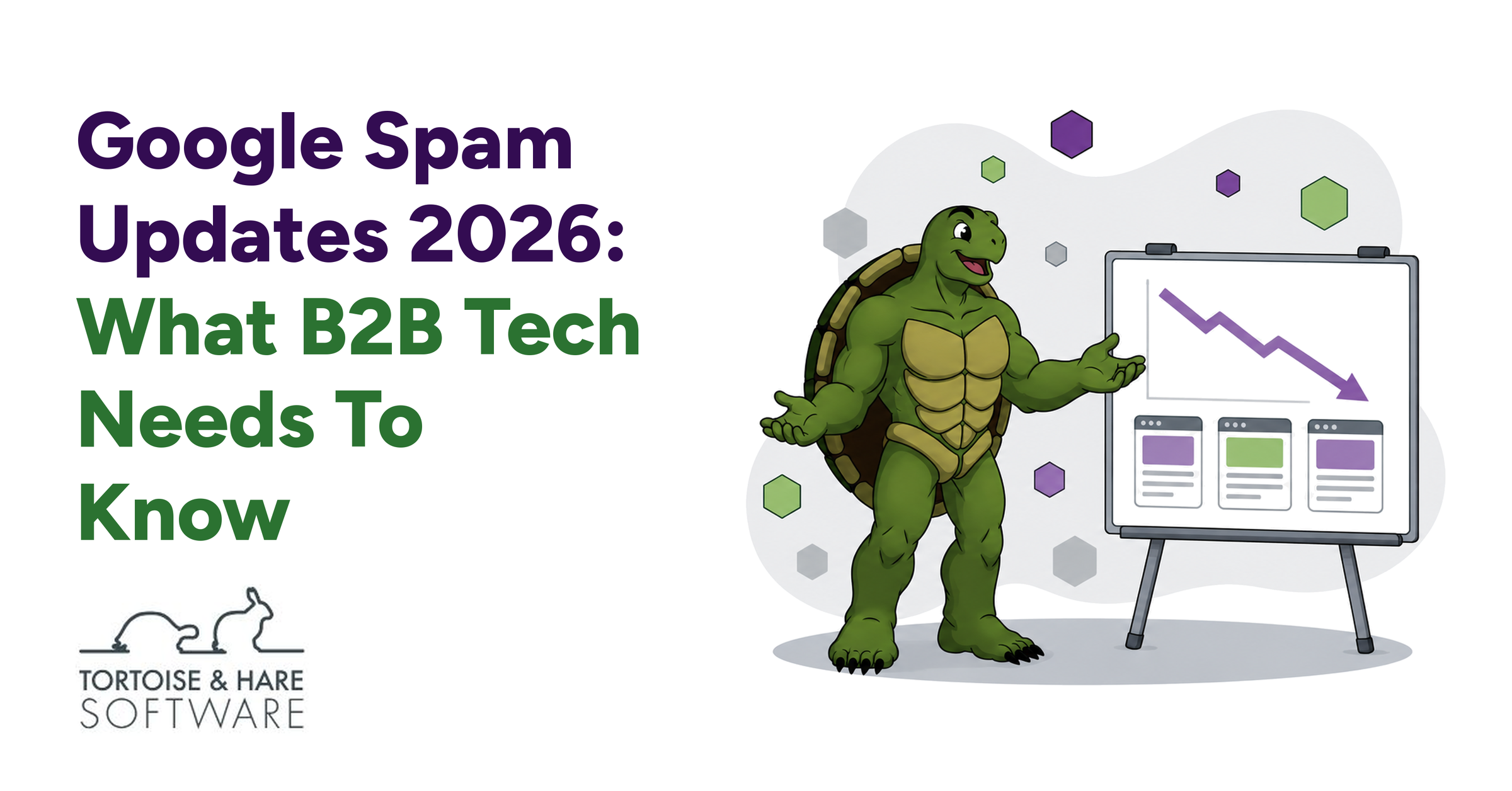
Your website is getting fewer visitors, even though your team is still publishing content and your business hasn’t changed. Older blog posts may have stopped bringing in readers. Location pages or “best providers” articles may have slipped. If you’ve spent years investing in your website, watching that progress disappear can be frustrating.
It’s been a tumultuous year in search. By early October, Google had launched four spam updates, with the August and September changes arriving barely a month apart. For an MSP, software company, cybersecurity firm, or IT consultancy trying to keep a sales pipeline moving, that is a lot of change to absorb.
This article covers the main content and SEO tactics coming under pressure from Google’s spam updates on B2B technology websites. Use it to spot where your site may be exposed and understand whether declining traffic could reflect spam enforcement, buyers turning to AI platforms for answers, or a combination of both. That distinction helps you decide whether to improve existing pages, adapt how buyers discover your business, or work on both.
Start by finding which pages lost visibility, how they contribute to enquiries, and what would make them more helpful to your buyers. You may need to maintain older articles, improve a shared page template, or address a shortcut that has stopped working.
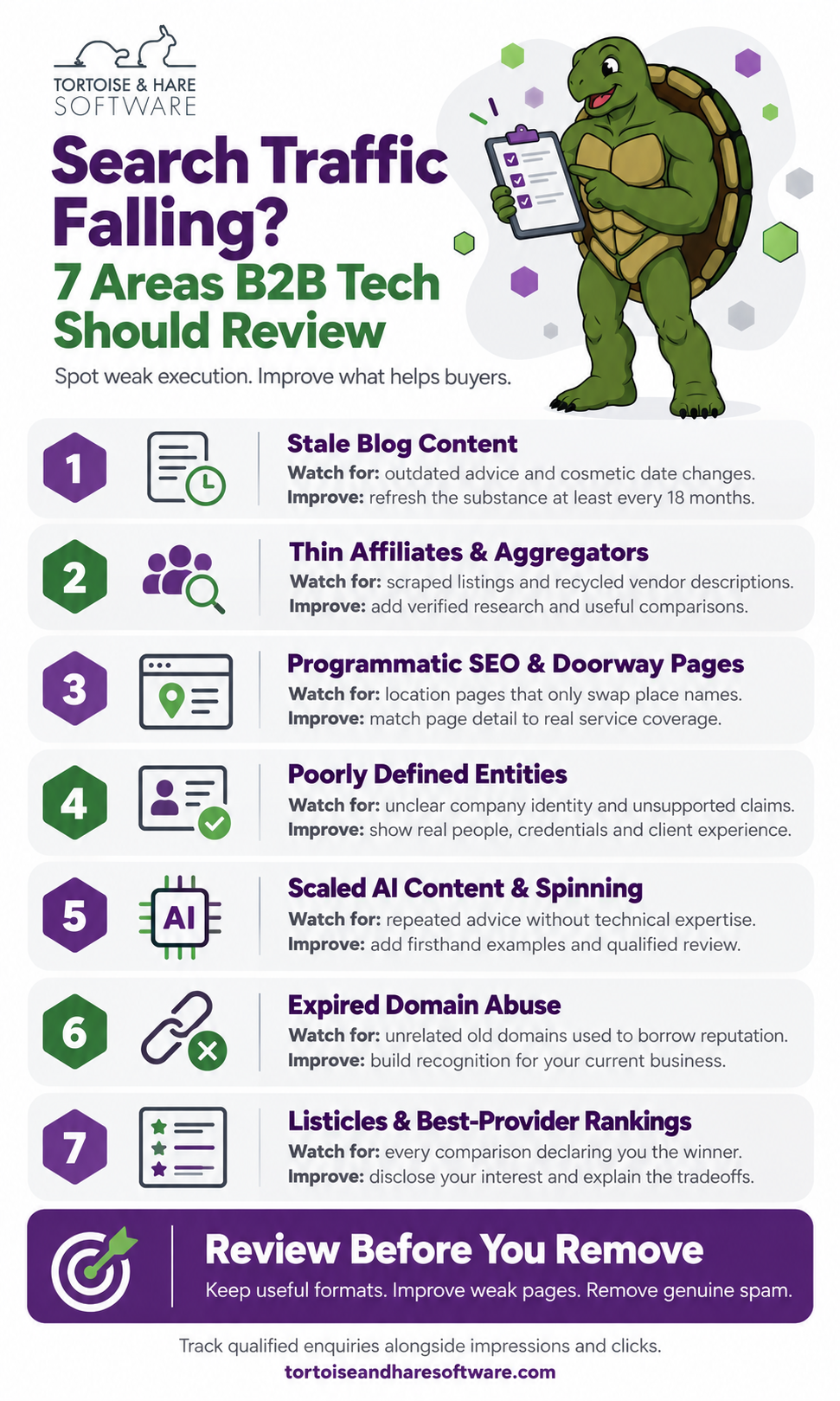
Start With The Pages Losing Traffic
Find out where the loss is concentrated: your older blog archive, city pages, software comparisons, or core service pages. Then compare those losses with enquiries and sales opportunities. Losing visits to a basic technology definition creates a different business problem from losing the service page that regularly brings qualified prospects to your team.
Educational content still matters. A practical guide can help a prospect understand a problem, evaluate your expertise, and return later to enquire. Look at how affected articles support those decisions, including whether they lead readers toward relevant services or comparisons.
Google Search Console is Google’s free reporting tool for your website. Impressions show how often your pages appeared in search results; clicks show how often someone visited from those results. A page can lose rankings while remaining indexed, meaning Google still includes it in its searchable collection of pages. Deindexing means it has left that collection.
If impressions and clicks fall together, look at the affected pages and their ranking and indexing changes. If impressions hold up but clicks decline, fewer people may be choosing to visit, including when answers appear directly in search. Those situations call for different responses.
Why Search Has Been So Volatile
The Google ranking release history records four spam updates this year:
| Update | Rollout |
|---|---|
| March Spam Update | March 24-25, 2026 |
| June Spam Update | June 24-26, 2026 |
| August Spam Update | August 18-21, 2026 |
| September Spam Update | Began September 24; no completion recorded as of October 6, 2026 |
A spam update changes how Google detects tactics that breach its rules, such as creating large amounts of low-value content to win rankings. A core update is broader: it changes how Google assesses which results deserve to appear. The timing of a traffic drop gives you a starting point, but the affected pages reveal more about what needs attention.
From where I sit, SEO is one of the industries AI has disrupted most. Everyone is trying to find the right balance between human judgment and AI assistance. The promise of faster, cheaper publishing has tempted many to take fully automated shortcuts. My read of this year’s repeated updates is that Google has declared war on web spam, and I expect that pressure to continue.
Spam can involve your own articles and service pages, known as on-page work, or links and brand mentions elsewhere, known as off-page work. The August update focused on content, but a broader review should consider both sides of your search presence.
Programmatic pages, listicles, affiliate comparisons, and AI-assisted writing can all serve buyers well. Many skilled SEOs use them for legitimate businesses. Review how they are executed: does each page help someone make a decision, or does it mainly create another opportunity to rank? Improve useful work that has lost ground. Remove hacked content, false claims, and genuine spam.
Where B2B Tech Search Traffic Can Decline And What To Improve
1. Stale Blog Content And Artificial Freshness
If you’ve lost a lot of search traffic, check your older blog posts. Find out which once-performing articles are losing impressions and clicks, and whether those pages still appear in Google’s index. An archive can lose substantial visibility while your core service pages remain relatively stable.
For example, an SEO reviewing B2B software businesses found that blogs and resource hubs accounted for much of their visibility loss. One brand lost 49% of its search visibility, with its blog suffering a much steeper decline than other parts of the website. Affected blogs used artificial date updates and repetitive publishing.
For an MSP, that might mean a Microsoft 365 migration guide with retired product names, missing licensing changes, and screenshots your clients no longer recognize. Updating the year in its title won’t help someone plan a migration. Revising the steps, explaining current limitations, and adding lessons from your team’s projects would. An older article can still be useful when its advice remains accurate.
The common workaround is cosmetic freshness: change the publication date or put 2026 in the title without maintaining the article. That can make a stale answer look current while leaving the same weak advice, broken links, and retired offers in place.
We recommend reviewing and maintaining blog posts at least once every 18 months. Update changing technical advice sooner. Check accuracy, sources, examples, links, and the next step for the reader. A material refresh should improve what someone learns. Our guide to excellent MSP SEO content explains the buyer needs that should guide that work.
2. Thin Affiliates, Aggregators, And Scraped Content
If comparison pages, provider listings, or referral sites are losing impressions and clicks, look at how much original value those pages provide. Thin affiliates and aggregators can take many forms, including software comparison sites, recommendation blogs, mirrored directories, and lead-generation marketplaces.
An affiliate refers visitors to another business and may earn a fee for a signup, sale, or qualified lead. An aggregator brings information from several sources together. In B2B tech, these models can help buyers compare software or find a service provider. The risk is publishing borrowed descriptions and recommendations without adding meaningful research, verification, or insight.
Scraping means collecting content from other websites, often with software. A thin site may copy that material directly or use AI to rewrite it, then compete for the same searches. Changing the wording doesn’t give buyers a better answer when the information and recommendations remain the same.
For example, a lead-generation site might scrape an established MSP directory and recreate its company listings as “best MSPs” pages. It collects enquiries without independently checking service coverage, technical skills, or the accuracy of the recommendations. A software comparison site can have the same weakness when it repackages vendor descriptions and funnels readers to paid referrals.
If you’re exposed here, add original comparisons, verified details, and clear selection criteria. Explain implementation costs, support limits, service coverage, and who each option suits. Disclose referral relationships and consolidate pages that repeat the same answer. The goal is to help buyers make a decision they couldn’t make from the source material alone.
3. Programmatic SEO Pages And Doorway Abuse
If you have lost visibility across several towns or service variations, compare the pages targeting those searches. Repeated losses across a similar set of pages can point to a shared template problem. The same issue can affect SaaS industry pages that change the industry name but offer the same generic answer.
Programmatic SEO uses a template and data to create many pages. Done well, it can make useful local information, service details, or software comparisons available at scale. The execution problem starts when only the city name, service, phone number, or area code changes and the page adds little else for the reader.
Choose geographic detail that matches how customers use your service. Neighborhood pages may make sense for an MSP with distinct onsite coverage in a focused part of New York City. A nationwide firm doesn’t need a page for every ZIP code simply to target more keywords. Each level of detail should give buyers useful information they wouldn’t get from a broader page.
For instance, an SEO reviewing affected sites identified losses among thin location pages and spun local content. A separate website owner described repeated declines across thousands of suburb pages. Another local lead-generation website found the same questions and service sections repeated throughout its city and service pages. A weakness in one template can spread across a whole section.
Consider a smaller example: an MSP has ten city pages, but each repeats the same service description with a different place name. A prospective client still can’t tell whether an engineer can visit their office, what support hours apply, or whether the team serves businesses like theirs. Add accurate coverage details, onsite arrangements, and relevant project experience where those differ. Keep pages that answer a distinct buyer need and combine those that repeat the same answer. Uniqueness should come from useful information, rather than simply rewriting the same paragraphs. Our MSP local SEO strategies discuss how to build a more useful local presence.
4. Poorly Defined Entities And Unsupported Claims
If keyword-focused sites are losing visibility while your main brand holds up, look at how clearly those sites identify the business behind them. Do visitors see a real company, qualified people, and evidence of work, or a collection of service claims with little support?
SEOs call this business identity an entity. A company name, team, service history, and consistent profiles help connect a website to a recognizable business. Sites with weak business identity and keyword-based domains have appeared among those losing visibility.
An exact-match domain is a web address based on a search phrase, such as “IT Support In Denver.” It can be legitimate. The shortcut is to create a convincing-looking business around the phrase, using invented authors, inflated credentials, fictional projects, or AI-generated staff photos presented as real people.
Fabricated proof can also creep into automated writing. For example, one software company removed a made-up case study from a published article while reviewing its content after a sharp visibility decline. Replace unsupported claims with documented projects, accurate credentials, and examples your team can substantiate.
Use real team members and approved client evidence. AI illustrations can serve a page, but they shouldn’t impersonate your staff or document work that never happened. Buyers should be able to verify the experience your content claims.
5. Scaled Content Abuse, AI Content, And Content Spinning
If traffic losses line up with a batch of recently published articles, review that batch as a group. Similar introductions, repeated advice, unsupported claims, and no contribution from your technical team can reveal how the content was produced.
The shortcut is a largely automated pipeline from keyword list to published article. Spinning takes an existing piece and changes the wording, sometimes many times, to create more search targets without new research. Either approach can fill a blog quickly.
For example, case studies of affected sites described steep losses for AI-assisted, template-driven content. On one site dominated by programmatic pages, losses extended across other sections too. Weak scaled content can put more than its own pages at risk.
For a smaller software company, daily impressions fell from 1,152 to 26. Its content review found that a publishing scheduler had produced an unintended burst of articles, many lacking original value. Automation had increased output without ensuring that the pages gave readers something useful.
Google’s AI guidance allows useful applications of the technology. The question is what expertise reaches the final page. For example, AI can help organize a cybersecurity article, while your engineers supply a real incident scenario, explain the tradeoffs in the response, and check the recommendations. That gives the reader practical knowledge beyond a summary of other articles. Have someone qualified review the advice before publishing. Our perspective on AI search and MSP lead generation connects this to buyer discovery.
6. Generic Informational Content And Off-Topic Publishing
If your blog’s traffic is falling but enquiries aren’t changing much, check what the lost visitors were searching for. Broad definitions and loosely related topics can generate impressive-looking traffic without reaching people who need your services.
The tactic is to chase every apparently easy keyword around a topic. An MSP ends up publishing basic definitions of dozens of technologies. A software firm builds a huge collection of general business tips. The articles expand coverage without adding much beyond answers already available elsewhere.
For instance, a B2B software company removed 161 templated blog posts after reviewing their performance. Of those posts, 112 had earned no clicks over a 90-day measurement period. The archive had grown, but most of those pages weren’t bringing visitors to the business.
The useful distinction is between answering an early buyer question and publishing material simply because a tool found search volume. An IT firm can explain ransomware in the context of recovery planning and client risk. A generic dictionary definition gives that buyer far less help. Keep the content connected to the decisions your prospects make.
7. Expired Domain Abuse
If an aged-domain lead-generation site loses visibility, or gains disappear after old domains are connected to your main website, review that history. An expired domain is an address its former owner stopped renewing. Existing links to it may have been earned for an entirely different purpose.
The shortcut is to buy that address and use its past reputation to rank new content. For an illustrative B2B example, a former community club’s domain becomes a software-provider directory. The club’s links haven’t established the new operator’s expertise.
Another variation redirects old domains to your company website, or uses a canonical tag, a piece of code naming a preferred version of a page, in an attempt to pass signals elsewhere. Redirects and canonical tags have legitimate uses. Using them to borrow an unrelated site’s reputation doesn’t make the new content valuable.
For example, a link-network operator reported an approximately 97% impression loss across a network using expired-domain authority and templated sites. Several changes preceded recovery. Google’s expired-domain policy focuses on low-value repurposing to manipulate rankings.
If your strategy depends on purchased domains, review their former purpose and fit with your current business. Build useful content around the services you actually deliver, and use redirects for relevant replacements or genuine business moves. Put future effort into earning recognition for your current company.
8. Listicles And Self-Promotional “Best Providers” Rankings
A listicle is an article organized as a list. It is a longstanding content format that can make complex choices easier to understand. If your comparisons and “best companies” articles are losing traffic, review the usefulness of the recommendations before deciding the format is the problem.
For example, an SEO reviewing SaaS websites losing visibility found self-promotional lists across several affected blogs. With self-ranking lists and repetitive templates, the concern is how much genuine help the comparison gives a buyer.
The weak execution is to publish a comparison, place your own company first, and make it look independent. Repeating that across industries, software categories, or towns creates many pages with the same conclusion, even when different buyers need different things.
For an MSP, a useful comparison might explain which providers offer onsite support, which specialize in regulated businesses, and which suit a small company without internal IT staff. For software, describe tested integrations, implementation requirements, pricing limitations, and situations where another product is a better fit. Disclose your interest and explain the criteria. Readers should leave understanding the tradeoffs, rather than seeing the same company declared best for everyone.
I see the current pressure on listicles as part of the search pendulum, and I expect well-executed comparisons to regain ground as the balance shifts. That is a reason to maintain useful lists, not delete the entire format. Keep the research current, strengthen the criteria, and improve the evidence behind each recommendation.
9. Link Spam And Private Blog Networks
When rankings fall, review the relevance and quality of the sites linking to you, especially if earlier gains depended on large volumes of placements. A backlink is simply a link from another site to yours. Links can suggest that other publishers find your business worth referencing.
A private blog network is a collection of sites controlled to build links. Other shortcuts include automated forum comments, excessive link exchanges, and paid articles sold mainly to pass ranking credit. An editorial-looking placement can be part of a link package rather than a publisher’s genuine recommendation.
Google’s link spam rules address these practices. Disclosed advertising links can be legitimate when marked appropriately so they don’t pass ranking credit. Automated link packages can create exposure beyond the content on your own website.
If your campaign relies on unrelated blogs or automated placements, shift toward links with a clear business purpose. Publish research, contribute useful technical insight, and build relationships with industry publications and partners. Handle paid placements as advertising with appropriately marked links. Prioritize relevance and real readership over a monthly link quota.
10. Manipulative Brand Mentions And Site Reputation Abuse
If visibility depends on repeated mentions across third-party articles, look at the substance behind those mentions. A recommendation supported by relevant experience gives readers more to work with than a generic claim that your company is a leading provider.
The shortcut is to manufacture apparent consensus. Operators arrange flattering articles, repetitive “best provider” mentions, or mutual recommendations: you rank me highly and I’ll do the same for you. A reader may see several apparent endorsements without realizing they come from the same arrangement.
A related approach places low-value lead-generation articles on an established publication to borrow its reputation. Known as site reputation abuse when it breaches Google’s rules, it is a separate issue from simply buying a legitimate advertisement.
Build mentions around verifiable reasons to discuss your business: client outcomes you can share, technical research, expert contributions, and relevant partnerships. Give publishers useful material, and disclose commercial relationships. For an MSP or software firm, a credible recommendation should explain who you help and why your experience matters.
11. Schema Markup Abuse And Unsupported Ratings
If search-result stars disappear, find out what produced them. That is a different symptom from every page losing rankings. Star eligibility can change even when the page remains available in search.
Structured data, also called schema markup, is code that describes a page to search engines. The shortcut is to label unsupported ratings or ordinary service pages in a way intended to win more attractive search listings. Readers may never see the same evidence on the actual page.
Some affected SaaS blogs also used ineligible rating markup. Google’s review snippet rules require visible review information and restrict self-serving organization and local-business ratings. A testimonial widget doesn’t automatically qualify an MSP’s own site for review stars.
If rating features disappear, align the markup with the reviews visitors can actually see and the features the page qualifies for. Remove unsupported ratings and use the appropriate content type. Keep genuine testimonials useful to buyers even when they aren’t eligible to produce stars in search.
12. Hacked Content, User-Generated Spam, And Search Spam
If Search Console shows hundreds or thousands of pages your team never published, investigate. Strange addresses, unrelated topics, and unfamiliar search-result titles can signal spam spreading through a compromised website or an unmoderated public feature.
Attackers can inject pages into a hacked site, while spammers can use comments, profiles, or searchable submissions to publish content under your domain. The purpose is to exploit your site’s visibility for someone else’s links and rankings.
For example, a compromised WordPress website had hundreds of thousands of injected URLs indexed before cleanup. On a smaller business website, the warning might be an unfamiliar group of pages promoting products or services you have never offered.
For a B2B tech website, the same risk can reach a blog, customer community, or internal-search feature that produces publicly accessible results. Treat unexpected pages as a publishing and security problem. Stop the entry point and remove the spam; changing the homepage copy won’t address what Google has found elsewhere on the domain.
13. Misleading Functionality And Lead-Generation Funnels
If a lead-generation site is losing visibility, look at what happens after someone arrives. Does the page deliver the promised comparison, quote, assessment, or provider information? Or does it send the visitor elsewhere and keep asking for details before offering anything useful?
The manipulative version builds pages for searches it doesn’t properly answer. A supposed local-provider guide redirects to an unrelated lead broker. A “free assessment” collects contact details without giving the visitor a clear view of what happens next. Heavy pop-ups and aggressive ads can make weak pages harder to use.
For example, one affected website combined poor usability with aggressive ads. Another sent visitors to riskier destinations and often failed to deliver what the search result suggested. More pages and stronger calls to action couldn’t compensate for an experience that didn’t fulfill the visitor’s purpose.
For MSP and SaaS lead generation, forms and calls to action should support the promised experience. Explain who receives an enquiry, what the offer includes, and what follows submission. Asking for contact details is normal. A misleading page that exists mainly to funnel traffic provides far less value.
Decide What To Improve First
You don’t need to rebuild every page because search has had a difficult year. Start with the parts of your website that have lost visibility and play a meaningful role in winning customers.
- Identify the affected pages. Separate losses in older articles, location pages, comparisons, and core service pages. Similar pages losing ground together can reveal a shared problem.
- Assess their role in the buying process. Prioritize pages that generate qualified enquiries or help prospects evaluate your services. Keep useful educational content connected to a clear next step.
- Improve the pages worth keeping. Correct outdated advice, add firsthand experience, explain service details, and make comparisons more specific. Give each page a clear reason to exist.
- Consolidate overlapping content and remove genuine abuse. Combine pages that answer the same need. Address fabricated claims, injected spam, and manipulative placements directly.
- Measure the business response. Track impressions, clicks, and indexing alongside qualified enquiries and sales opportunities. Restoring relevant buyer traffic matters more than replacing every lost visit.
Google has a difficult balance to strike. Many skilled SEOs represent quality businesses and help buyers find them. If enforcement is too soft, manipulated pages crowd out useful results. If it is too aggressive, worthwhile businesses and helpful content can lose visibility too. Either outcome can make search worse.
I expect the pendulum to keep swinging as Google adjusts its systems and marketers adapt. Search results are likely to remain volatile, and good content formats may regain ground. Use that uncertainty as a reason to maintain and improve your work, rather than waiting for rankings to rebound on their own.
Build A Search Presence That Reflects Your Service Quality
A year like this can make it tempting to chase the next shortcut. I would use it as a reason to bring your marketing closer to the business you’ve built. Your team, client experience, and practical knowledge give you material that a copied article or recycled domain cannot supply.
At Tortoise and Hare Software, we help B2B tech companies make those strengths easier for buyers to find. Our SEO services for MSPs support managed service providers, while our broader B2B technology SEO services serve software, cybersecurity, and IT consulting firms.
If this year’s changes have reduced the traffic and enquiries your business relies on, book a free consultation. We’ll help you identify where visibility has fallen and prioritize improvements to your content, search presence, and lead generation.
About The Author