How We Structure The Tortoise & Hare Software Marketing Team
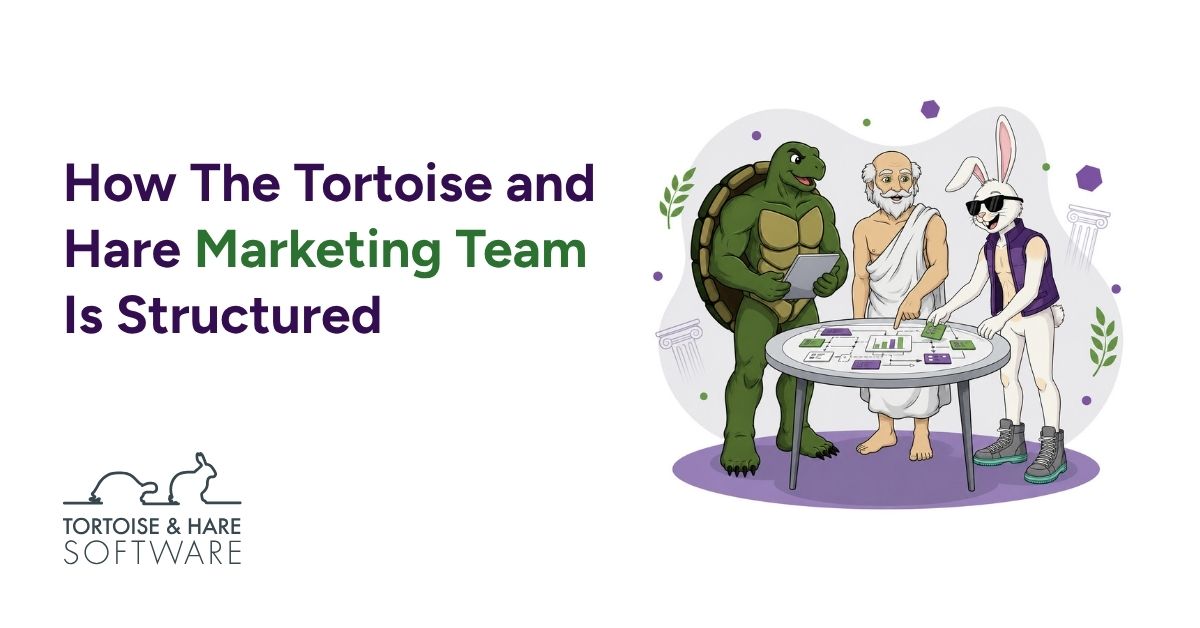
As Tortoise & Hare Software has started working with larger clients, we’ve been getting more questions about the team behind the work. Not just what we do, but who is actually writing the copy, designing the ads, building the pages, managing campaigns, and keeping projects moving.
That makes sense. If you’re hiring an agency, you probably want to know whether you’re working with one person doing everything or a team with clear roles. So this post is a look at how our team is structured, what each person works on, and where AI agents fit into the process.
The Team In One Minute
- Hunter Nelson: Leads strategy, manages campaigns, and stays involved in day-to-day decisions.
- Copywriter: Handles landing pages, blog posts, emails, social copy, and editing.
- Designer: Creates ad creative, featured images, website graphics, and other campaign visuals.
- Web developer: Builds pages, publishes content in WordPress, updates websites, and handles technical fixes.
Those four roles cover most of what we do for clients. The titles are simple. The way projects move through the team is a little more interesting.
How A Project Moves Through The Team
Most projects start with a decision about what we’re trying to accomplish and what needs to be made. That could be a new service page, an onboarding guide, a blog post, a weekly email, a LinkedIn campaign, or a new Google Ads ad group. The goal, audience, source material, and any limits go into ClickUp so everyone is starting from the same place.
- Plan: Set the direction, write the brief, and decide how the page or campaign fits with everything else.
- Write: Our copywriter creates or edits the copy for the page, article, email, or social post.
- Design: Our designer creates the graphics, ad templates, featured images, or page visuals.
- Build and publish: Our web developer turns the approved copy and design into a live page or adds the finished content to WordPress.
- Review and improve: Check the finished piece, connect it to the campaign, and decide what needs to happen next.
It isn’t always a straight line. A landing page may go back to the copywriter after we see the design. The designer may need a different headline length for an ad. The developer may spot something in WordPress that changes how a section should be laid out. The point is that everyone knows where they fit and who owns the next step.
What Each Person Actually Does
Strategy, Campaigns, And Direction
The strategy role stays close to campaign decisions. It covers service-page planning, landing-page audits, search-intent decisions, content planning, paid-search changes, and tracking setup.
- Plan new service pages, guides, email campaigns, and content topics.
- Review landing pages and decide which page should rank for which search.
- Manage Google Ads and add ad groups or keywords when we find a new opportunity.
- Handle much of our LinkedIn advertising and coordinate with our designer on the creative.
- Review tracking, calls, forms, and campaign tagging so we know what is producing a response.
- Approve final direction when copy, design, development, or campaign choices cross over.
Copywriter: Landing Pages, Blog Posts, Emails, And Social Copy
Our copywriter handles the bulk of our writing and editorial review. Recent projects include service landing pages, buyer-focused blog posts, email campaigns, and batches of social posts.
- Draft landing pages for services such as cloud services and network monitoring.
- Write blog posts that answer buyer questions about pricing, risk, security, and technology.
- Create emails tied to a specific issue, article, or campaign.
- Turn a larger topic into several social posts with different angles.
- Review drafts for accuracy, tone, search intent, and whether the copy sounds like the client.
Designer: Ad Creative, Featured Images, And Website Graphics
Our designer gives campaigns and pages their visual shape. Recent projects include reusable LinkedIn ad templates, featured images for MSP landing pages, industry-page graphics, team illustrations, and social content.
- Design LinkedIn ad templates that can be adapted for different industries.
- Create featured images for landing pages and blog posts.
- Produce graphics for industry pages, team sections, and other parts of a website.
- Adjust headlines, photos, colors, and layouts so a template fits the campaign.
- Prepare social graphics and other visual pieces needed for the content calendar.
Web Developer: Websites, WordPress, And Technical Cleanup
Our web developer handles the final mile between an approved idea and the website. Recent projects include WordPress uploads, page migrations, website edits, footer and policy links, broken-link fixes, and full website builds.
- Build and update landing pages and websites.
- Publish landing-page copy and blog posts in WordPress.
- Move pages, policy content, and footer links from an old site to a new one.
- Fix broken links and other issues found during site audits.
- Make smaller website changes after launch, including bios, page copy, and layout updates.
- Check pages with the rest of the team when search intent, page structure, and publishing choices overlap.
AI Agents Act As An Extension Of The Team
AI agents aren’t a separate step that gets added at the end. They act more like an extension of the team. They can research, organize source material, draft copy, prepare graphics, and handle other repeatable parts of a project. That gives the people on the team more time to focus on the decisions that shape the final result.
The biggest change is the set of questions people spend their time answering. There is less focus on “How do we execute every part by hand?” There is more focus on “What does the agent need to know before it can produce something useful?”
- Where does the client sit in the market today?
- How are competitors positioning similar services?
- What is the gap between where the client is now and where they want to be?
- What messages and proof points need to appear in the page, post, ad, or graphic?
- What source material, examples, and brand context should the agent receive?
- What should a strong output accomplish for the client?
That shift gives individual contributors more of a marketing-manager and strategist mindset. Their job is increasingly to gather the right information, give the agent useful direction, review what comes back, and improve it until it fits the client. The hands-on skill still matters, but it is paired with more judgment and a broader view of the campaign.
The copywriter is an easy example. They can ask an agent to draft a landing page or blog post, but the quality of that draft depends on the brief, source material, positioning, and examples supplied to the agent. The copywriter reviews the result for facts, voice, structure, and the client’s point of view. They still own the finished copy.
The designer follows a similar approach for some graphics. Our brand-graphic agent can prepare featured images inside a Canva template. The designer supplies the prompt and brand context, reviews the options, approves the template change, fixes spacing or colors, checks the brand character, and exports the final image. The agent handles a repeatable first pass. The designer handles taste and the final decisions.
We aren’t typing one vague prompt and sending the result to a client. A person frames the assignment, chooses the inputs, reviews the output, and owns the finished page, post, ad, or graphic.
PRESTO Is The Framework Behind Our Content
PRESTO is hard to separate from how we write because it now guides most of our content. The PRESTO copywriting framework started as a way to develop landing pages. Landing pages are still a major use for it, but we’ve extended the same structure to blog posts, social media copy, and other client content.
The framework moves a reader through Pain, Resonate, Educate, Simplify, Testify, and Offer. More importantly, it keeps the focus on our clients’ customers. For an MSP, that means understanding why a business owner is shopping for help, what problem pushed them into the market, what they need to understand, what proof will make them comfortable, and what they should do next.
That shared structure makes the team more efficient. We don’t need to get into a room and invent a new way to approach every landing page, article, or social post. We already know the questions that need to be answered and the order in which the story should unfold.
The harder and more valuable part is gathering the right inputs. The team still needs to understand the client’s market, competitors, current position, goals, message, proof, and point of view. That context is then supplied to the agents and translated into a client-specific use of PRESTO. The method stays consistent, while the copy and ideas reflect the company the content is being written for.
A Long-Term Staffing Partner Gives Us A Flexible Bench
We’ve worked with the same marketing-focused staffing agency for more than five years. They supply all of our current contractors and understand how Tortoise & Hare Software operates. That history matters. We aren’t starting from scratch with a new staffing company every time demand changes.
When demand increases, we can add hours for the current team, bring in a dedicated SEO specialist or PPC analyst, or reconnect with people we’ve worked with before. They already know us, and many already understand our tools, standards, and clients. When demand shifts again, we can adjust without rebuilding the entire team. That flexibility is one of the strongest assets in the business.
Final Thoughts On The Tortoise and Hare Marketing Team
Tortoise & Hare Software doesn’t look much like it did 18 months or two years ago. AI agents have become part of how we operate. PRESTO has expanded beyond landing pages. Individual roles have moved away from doing every task by hand and toward gathering context, setting direction, and reviewing what the agents produce.
We’re also a technical team as much as a marketing team. We’re comfortable connecting websites, content, paid media, tracking, integrations, and AI-assisted production into one marketing system. That lets us run larger and more complex marketing programs without treating every channel as a separate project.
The team will probably look different again two years from now. New tools will appear, client needs will change, and the market will keep moving. Between our staffing partner, AI agents, technical skills, and can-do attitude, we’re confident the team can keep adapting. That same ability helps our clients adjust as their own markets change.
Questions? Ready to learn more? Book a free consultation.
About The Author