Why SEO Keyword Visibility Reports May Fluctuate As Google Restricts SERP Scraping
A sudden drop in your SEO report can make months of progress seem to vanish. Keywords that ranked last month are missing. A visibility score falls sharply, then rebounds just as quickly. If you pay for SEO to bring in leads, you deserve to know what those swings mean.
Right now, one explanation is that Google is making its search results harder for third-party tools to collect. Its new google.com/goto links are part of that shift. As SEO tools adapt, your reports may give you a less accurate view of where you rank.
We expect more errors and sharp swings in keyword visibility reports over the next few months. The change makes it more important to understand what each report shows and to judge progress over months rather than days.
What Happened In Google’s SerpApi Lawsuit
SerpApi collects search results and sells them in a format other software can use. Its name comes from “search engine results page,” or SERP, and “application programming interface,” or API. Instead of a person searching Google and copying the results by hand, a program can request the data from SerpApi.
Google sued the company in December 2025. In its original complaint, Google said SerpApi was sending hundreds of millions of automated searches each day. It alleged that SerpApi made those requests look like visits from people by using simulated browsers and many different IP addresses.
Google also said SerpApi got around SearchGuard, its system for blocking bots. The alleged methods included bypassing CAPTCHA tests and disguising the device or location behind a request. Google argued that this let SerpApi collect and resell content that Google had licensed from others, including photos in its information panels.
The legal claim centered on the Digital Millennium Copyright Act, or DMCA. This law includes rules against getting around digital locks that protect copyrighted works. Google argued that SerpApi had crossed that line by bypassing its defenses. These were Google’s allegations, which SerpApi disputed.
On July 20, 2026, the court dismissed Google’s original claims. Google couldn’t bring the same claims again for results with no copyrighted content. The court did allow Google to revise its claims about results that included copyrighted material. Google filed a revised complaint, and SerpApi asked the court to dismiss it in August.
Google lost that round in court, but it still wanted to stop companies from collecting its search results at scale. With its original legal claims dismissed, technical defenses offered another way to protect that data. One of those defenses is /goto links, which Google expanded after the ruling. The links were already being tested beforehand, so the court loss wasn’t the start of that effort.
How Google’s /goto Redirects Affect SEO Tools
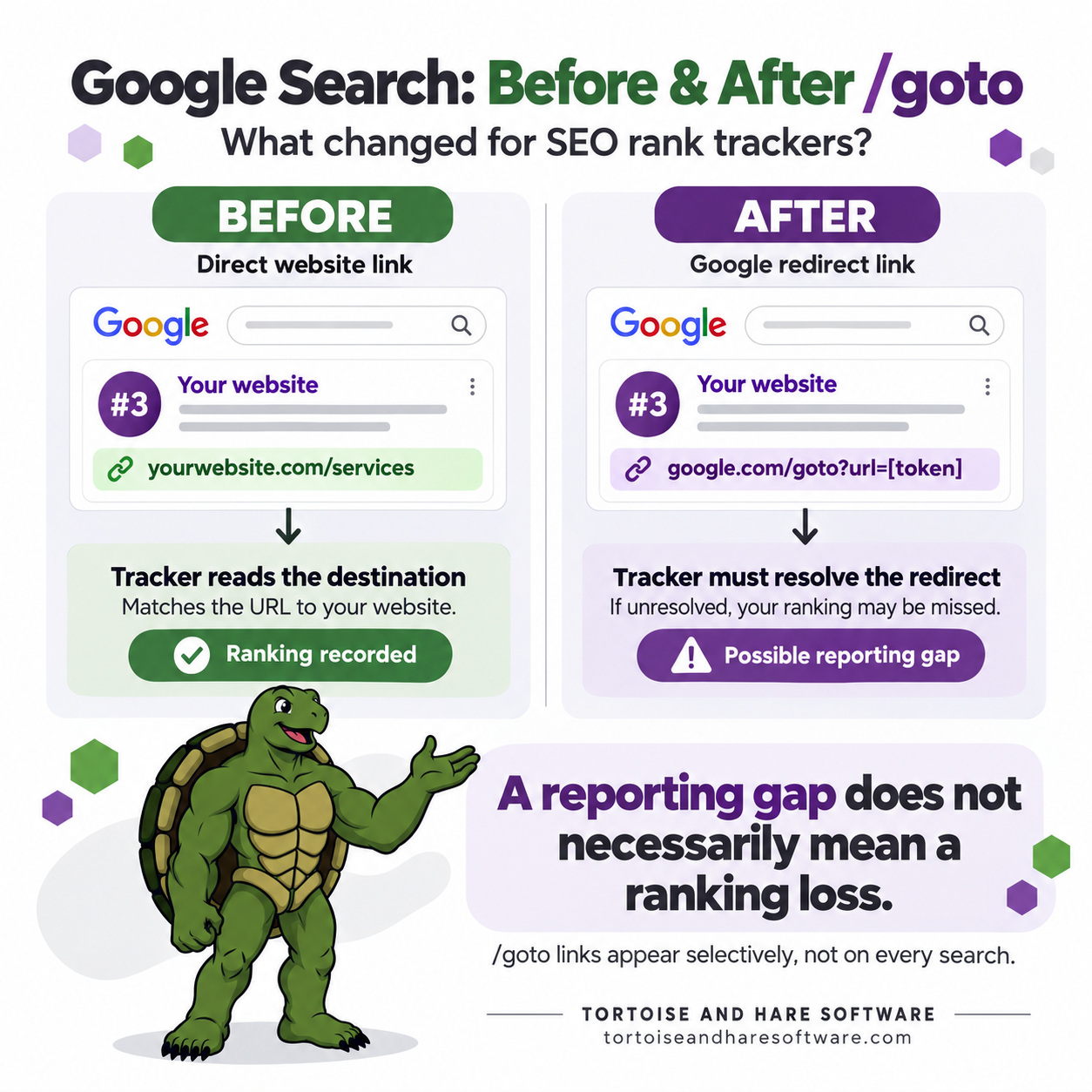
A /goto link is a Google-owned redirect that sits between a search result and the website it leads to. Instead of linking straight to your page, Google uses an address such as google.com/goto?url=[token]. When someone clicks, Google sends them on to the right page. The token isn’t your website’s raw URL. It’s an opaque value that cloaks the destination, so a scraper can’t simply read the link and pull out your page address. This makes scraping harder: the tool has to resolve Google’s redirect to find out where the link leads.
Google confirmed the rollout in August, saying the change helps protect its services and users from abuse. For most people, there’s little to notice. An SEO tool has more to figure out: it has to find the website behind the Google link. If it can’t, it may fail to record your ranking.
Not every search results page uses /goto links. They appear to be served selectively, so one search session may show them while another doesn’t. A tracker has to handle both types of links, which can make problems uneven: some keywords may track normally while others are missed or read incorrectly.
This is a change to Google’s search links. It doesn’t mean you need to change your website or that Google has lowered your rankings. The problem is how well an SEO tool can read the results.
If a tool can’t read the destination, it may list a result as google.com and fail to match it to your page. It may then give the wrong site credit in reports that compare your share of search results with other firms. Those errors make it harder to compare results over time.
Why Reports May Keep Fluctuating Over The Coming Months
Many tracking companies are changing how they gather and read the results. But fixing /goto links doesn’t mean the dust has settled. We expect Google to keep testing new defenses, with tools having to adapt each time. That can leave periods when some keyword data is wrong, late, or hard to compare.
Google’s search data is valuable. It helps software find useful pages and gives AI platforms a way to look up information for their answers. Companies want access to that data, and Google wants to control how it’s collected and reused. In Google’s view, companies such as SerpApi abuse that access by bypassing its defenses and reselling licensed content.
Our view is that Google’s main concern goes beyond a simple SEO tracker checking where your website ranks. The larger conflict is over companies collecting search data at scale and using it in other products. SEO trackers are caught in the crossfire because they rely on access to those same results.
This isn’t Google’s first change to how tools gather search data. Our article on the num=100 change explains an earlier change that made it harder to track results beyond the first page. The /goto links add a new challenge: finding which website a result belongs to.
Imagine your MSP ranks on page one for a key service search. Its tracker can’t read the link and lists the page as missing. Once the tool changes how it reads the links, the page shows up in the report again. The chart shows a loss, then a gain. Buyers could find the page the whole time.
Your visibility score can swing with those missing rankings. The drop and the rebound may come from changes in how the tool reads the data, or whether /goto links were present when it checked the search results. A sharp move on a chart needs context before it can be treated as a gain or loss.
Search Console And SEO Trackers Show Different Views
Google Search Console is the source of truth for your website’s reported performance in Google Search. Its data comes from Google itself. It shows how often your pages appeared, how many clicks they received, and their average position. It doesn’t depend on a third-party tool scraping search results.
SEO trackers answer a different question: where does your website appear for a chosen search in a chosen market? Search results depend on the searcher’s context. Google can factor in their location, device, language, and, where applicable, search history or personalization settings. Two people searching for the same thing may see different results.
Trackers act like virtual searchers with specific settings to simulate parts of that context. They can check results as though someone were searching from a particular city or state on a phone or desktop. Keeping those settings consistent makes it easier to compare rankings over time and track competitors for the same keywords. It’s a view of search results under those conditions, rather than a single ranking that every buyer will see.
For an MSP serving several cities, that view is useful. Your website might rank well for managed IT services in one city and barely appear in another. A location-based tracker helps reveal that gap. Search Console reports the searches where your site appeared, but it doesn’t offer the same city-by-city view or show where every competitor ranks.
Both have value. Search Console shows your recorded Google Search performance. Trackers provide a more controlled view of selected keywords, locations, and competing websites. Their numbers won’t always match because they measure different things. Google’s average position metric combines results across the searches where your site appeared, rather than showing one fixed rank for everyone.
Focus On Traffic Growth And Deeper Market Penetration
Keyword trackers remain useful for medium- and long-term trends, even while daily values are more volatile. Over months, they help show whether your website is gaining a larger share of search visibility relative to competitors for your targeted keywords. Short-term swings should be expected while tools adapt, but reports should remain largely accurate for assessing the direction of long-term trends.
In this SEO context, market penetration means your percentage of visibility relative to competitors across a defined set of targeted keywords. Deepening that penetration means gaining a larger share of visibility for those searches. The comparison should use the same keyword set, location, and device settings over time.
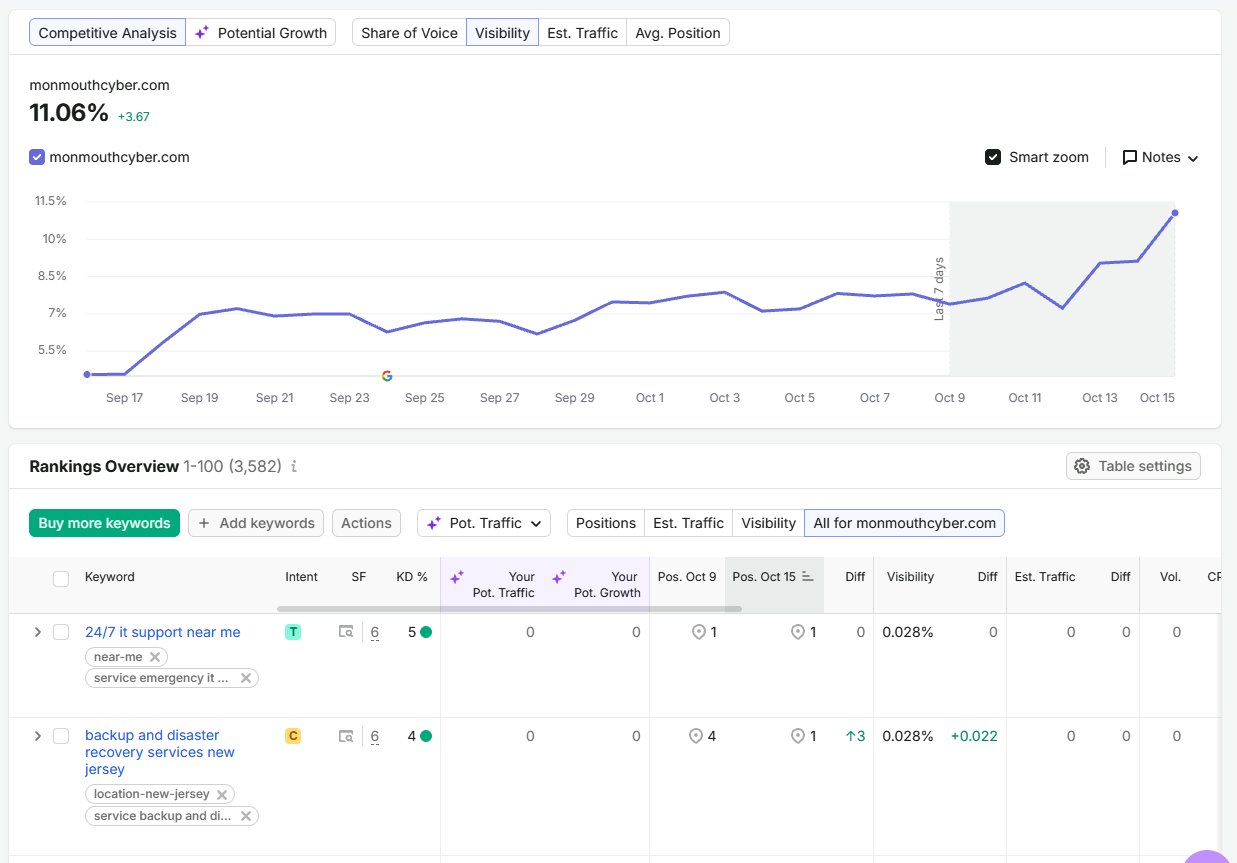
For example, imagine an MSP’s share of visibility rises from 10% to 20% across the same targeted keyword set and competitors. That shows it’s capturing a larger share of the search visibility being measured. It doesn’t mean the MSP has 20% of the customers in that market. The tracker shows its competitive search presence, while Search Console shows how its Google impressions and clicks are changing.
The useful questions are whether traffic is growing over time, whether the right service pages are gaining visibility, and whether the business is gaining visibility relative to competitors for its targeted keywords. Our guide to search performance metrics explains how these measures fit together.
Lead Volume Also Depends On Market Demand
More visibility on commercial searches usually creates more chances to generate leads. But lead volume can still rise and fall while search visibility improves. A company may rank well when fewer businesses are looking to switch IT providers, approve a project, or commit to a new monthly expense.
Economic conditions, budgets, and buying cycles affect demand. Companies competing in the same market face those wider pressures, though the impact will vary by customer base and offer. A slow month for enquiries doesn’t, by itself, show that an SEO campaign has lost ground.
Businesses have the most direct control over their inputs: the effort they invest, the quality of their pages, the services and locations they cover, and how consistently they improve the website. Search visibility is an outcome those inputs can influence, alongside competition and Google’s ranking systems. The practical aim is to build a stronger presence where buyers search, so the business has more chances to win when demand is there.
Read Short-Term Swings In A Longer-Term Context
Google’s defenses and the tracking tools built around its results are likely to keep changing. Daily rankings may be noisy during that process. The more useful view combines Search Console’s performance data with the competitive visibility shown by SEO trackers, with attention on sustained traffic growth and a larger share of visibility for targeted commercial keywords.
If you need help understanding your search performance, our marketing analytics services connect the data with your growth goals. Book a free consultation to discuss your search visibility and opportunities to reach more buyers.
About The Author